Spring ‘26 News & Updates
As we close out the spring semester, the JC has several exciting updates to share!
New Research and Reports
Strengthening Readiness for Decarceration
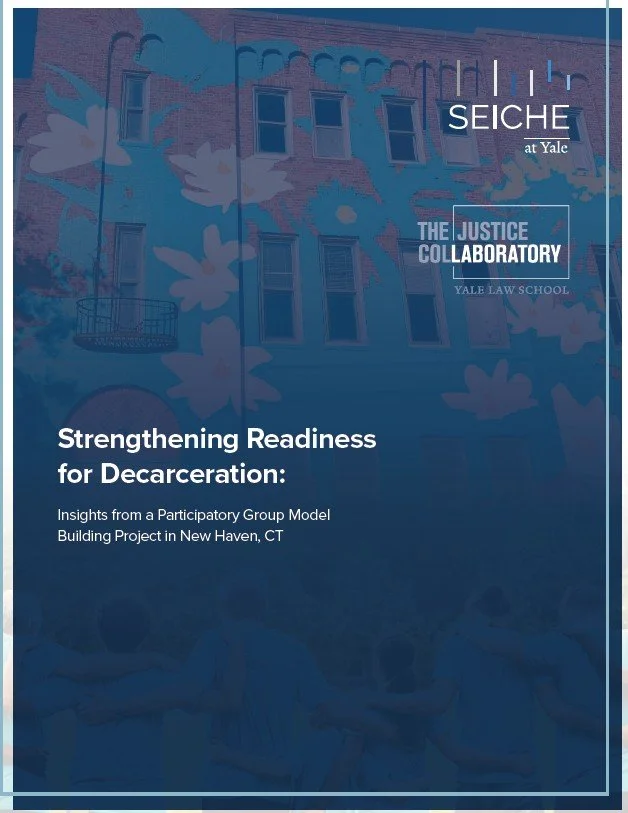
In fall 2025, The Justice Collaboratory and Seiche Center at Yale convened community stakeholders from across New Haven and Connecticut to examine decarceration using a method called group model building. This participatory systems science approach brought together people with diverse expertise and lived experience to map complex systems and identify where change can have the greatest impact. Participants included people who were formerly incarcerated, people impacted by gun violence, city and state officials, law enforcement leadership, educators, health care providers, researchers, and leaders of social service and grassroots organizations. Across three facilitated sessions, participants developed a shared model of the drivers and consequences of incarceration in New Haven and identified action ideas with potential to advance decarceration.
AI, Trust & Procedural Justice
JC Executive Director, Caroline Nobo, is leading The JC’s newest research focused on building trust and legitimacy with AI and emerging technologies. She recently presented at the International Conference on Technology, Knowledge, and Society and the AI at Yale Innovation to Impact Symposium. The JC is welcoming a full-time AI research fellow in Fall 2026, and has two upcoming papers on AI and trust, and procedural justice in the works—one in court settings, the other focused on content moderation.
Coming Soon: National POST Report
Police Officer Standards and Training (POSTs)—state agencies that set minimum educational requirements for police officers, maintain professional standards, and oversee the state police force—vary widely by state. This summer The JC will be publishing a report that, for the first time, comprehensively tracks how states regulate the police through police officer standards and training commissions, which play an important but often overlooked role in police oversight nationwide.
Announcing Justice Fellows: Coming Fall '26
The Justice Collaboratory is pleased to announce the launch of its Justice Fellows Program, beginning in the fall of 2026. The Program, designed for Yale undergraduates, will provide an interdisciplinary foundation for examining the frameworks that shape conceptions of justice. By offering special events, internships, and JC courses, Fellows will have access to a program that is both theoretically grounded and empirically informed. Fellows will be encouraged to synthesize perspectives drawn from history, philosophy, political theory, law, public health, and the social sciences. The Justice Fellows Program will enable students to investigate the interrelated notions of fairness, rights, citizenship, equality, law, and social control, and to consider how these ideas emerge and interact across disciplinary boundaries. The program will serve as a curricular structure for sustained reflection on justice in the real world rather than a fixed ideal.
Applications for the inaugural Justice Fellows cohort will be available in late summer.
New JC Blog Spots
Benjamin Justice: Internet Access for Incarcerated Persons
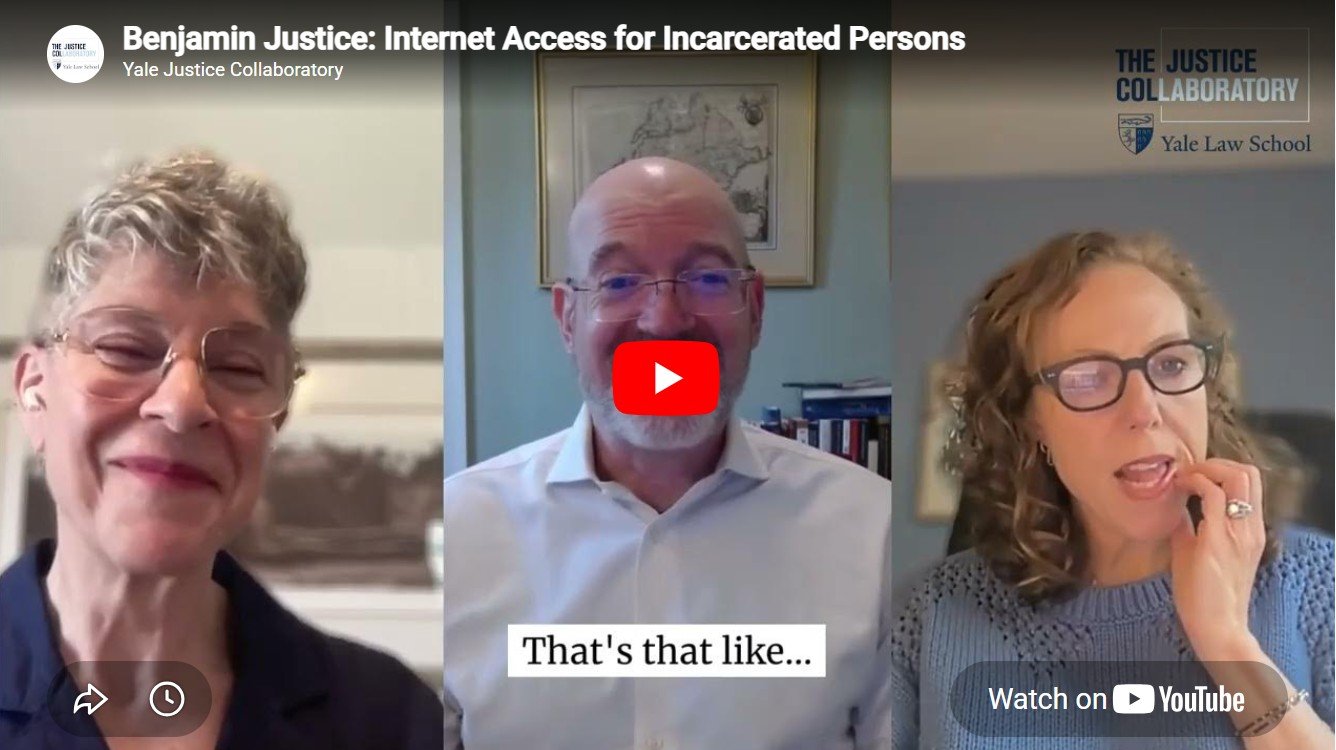
What are prisons doing to prepare for the inevitable emergence of smart prisons that integrate digital technologies, such as Artificial Intelligence (AI) and the Internet of Things (IoT)? What are the implications of depriving incarcerated persons of access to information technology?
Justice Collaboratory member Dr. Benjamin Justice and Professor of Education at Rutgers University discusses a recent NJ State Policy Lab report he co-authored with Ra’Zulu Ukawabut called: Computing on the Inside: Recommendations on Internet Access for Incarcerated Persons in NJ. This report seeks to explore and recommend policies for online access for people incarcerated in New Jersey state prisons.
Notebook Spotlight: Solidarities Across Prison Walls
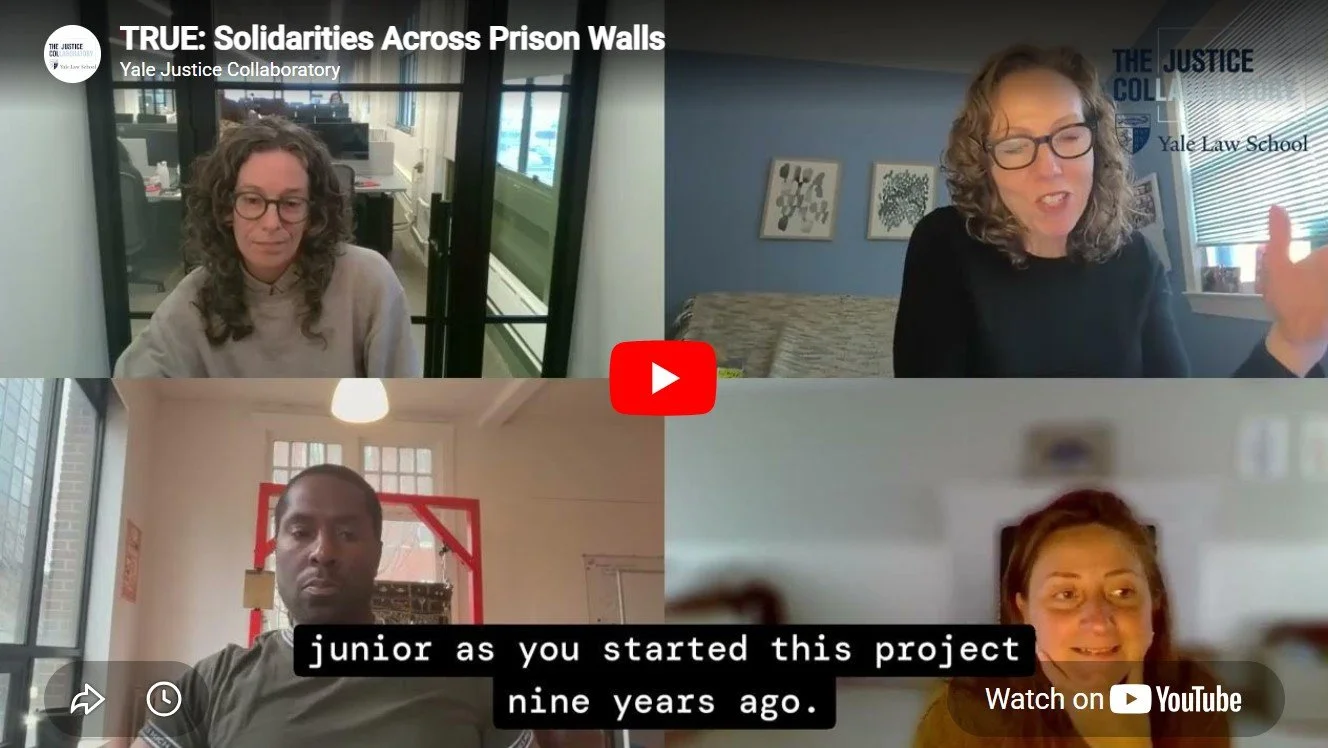
Vera Staff Ryan Shanahan, Selma Djokovic and Former TRUE Mentor James Davis came together to discuss their partnership with the Connecticut Department of Correction (DOC) to create the TRUE young adult housing unit at Cheshire Correctional Facility. In the nine years since it was founded, the unit has reported zero incidents of violence and has transformed daily life for hundreds of young adults. The development of TRUE required collaboration between Vera staff, DOC leadership, Cheshire staff, incarcerated people and their families.
New Webinar Recordings
Throughout the Spring 2026 semester, The Justice Collaboratory held a series of webinars with The Notebook’s contributors. Panelists shared lived experiences, research insights, and on-the-ground strategies that illuminate how solidarities take root in addressing some of the nation’s most imminent threats to safety and justice today.
Carceral by Another Name: Reforming Civil Commitment: As the administration expands civil commitment laws, this urgent webinar examined the legal, ethical, and human impact of carceral civil commitment practices and explored pathways toward reform grounded in solidarity and care.
Panelists:
Marisol Orihuela - Clinical Professor at Yale Law School and Director of the Mental Health Justice Clinic
Kristin Lummus - Former public defender and legal educator with expertise in mental health law.
India Mills - Conservator of a family member who is civilly committed.
Safer, Stronger, Together: Building Safe & Connected Communities:The founders of Maryland’s Safer, Stronger, Together initiative shared insights on leveraging interagency collaboration and Community Action Boards (CAB) to reduce crime and improve outcomes for Maryland youth.
Panelists:
Vinny Schiraldi, former Maryland Secretary of Juvenile Services
Seema Gajwani, Executive Director of Maryland’s Safer Stronger Together
Community Violence Intervention: Building Data & Relationships: This webinar explored collaborations between researchers and practitioners working in community-based violence intervention, highlighting lessons learned and opportunities for shared impact.
Panelists:
Teny Oded Gross, founder and CEO of Institute for Nonviolence Chicago
Andrew V. Papachristos, Professor of Sociology and the Faculty Director of CORNERS: the Center for Neighborhood Engaged Research & Science at Northwestern University
Sam Castro, Chicago Community Violence Intervention (CVI) Worker
Final Webinar: May 19, 1:00PM EST
Using Narrative to Move Policy: This conversation will offer strategies for collecting and leveraging powerful stories that shift public understanding and influence policy change, particularly within justice reform movements.
Panelists:
David Gaspar, The Bail Project CEO
Jenny Espinoza, Back to the Start CEO
The JC Hosts The Atlantic’s Vann Newkirk
The JC held two events with Poynter Fellow Vann Newkirk in April. Newkirk, Senior Editor of The Atlantic and the host and co-creator of narrative podcasts Floodlines and Holy Week, spoke to Yale students during a tea at Silliman College and held a guest lecture for the Yale community at the law school. In a lecture entitled Rediscovering Du Bois for a Media in Crisis, he spoke about the state of journalism and information today.
Don’t forget to read The Notebook!
The Notebook, a cross between a popular magazine and an academic journal, blends the perspectives of academic research and lived experience using writing, visual art, and interdisciplinary exchange to examine themes of safety, justice, and solidarity.
Volume 2 explores solidarities: the connections we build, the collective actions we take, and the communities we nurture across geographies, struggles, and imaginations to build a more just legal system.
Download for free or purchase limited print edition of The Notebook, Volume 2- a 175-page collection of original art, scholarship, opinion, and insight.
Copyright © Yale University • All rights reserved