
Reports
At the Justice Collaboratory, we’ve undertaken a variety of projects involving the study of procedural justice in both legal and community settings. Examples of our legitimacy and procedural justice work include the following reports.
Strengthening Readiness for Decarceration
In fall 2025, The Justice Collaboratory and Seiche Center at Yale convened community stakeholders from across New Haven and Connecticut to examine decarceration using a method called group model building. This participatory systems science approach brings together people with diverse expertise and lived experience to map complex systems and identify where change can have the greatest impact. Participants included people who were formerly incarcerated, people impacted by gun violence, city and state officials, law enforcement leadership, educators, health care providers, researchers, and leaders of social service and grassroots organizations. Across three facilitated sessions, participants developed a shared model of the drivers and consequences of incarceration in New Haven and identified action ideas with potential to advance decarceration.
The People’s Safety: How Cities Can Protect Local Control Over Public Safety
What do we do when federal scare tactics come to town?
This is the question that the Center for Policing Equity (CPE), in partnership with the Justice Collaboratory at Yale Law School, seeks to help answer. Recent events make clear that this question is no longer theoretical. Our goal is to identify political and legal strategies that enable local and state officials to prepare for, prevent, and respond to unwarranted federal and military intrusions into matters of local public safety. Through engaged conversation with multiple partners with front-line experience, threecategories of action emerge.

How do Communities Respond to Gun Violence Prevention Policies? (Infographic)
The primary goal of this project was to explore how gun violence prevention work impacts individuals considered at high risk of being directly impacted by gun violence. The current study aimed to elevate the voices of gun violence prevention program participants and impacted communities who can best attest to the influence and power of the message and services received.

How do Communities Respond to Gun Violence Prevention Policies?
The primary goal of this project was to explore how gun violence prevention work impacts individuals considered at high risk of being directly impacted by gun violence. The current study aimed to elevate the voices of gun violence prevention program participants and impacted communities who can best attest to the influence and power of the message and services received.
Beyond Moderation: Emerging Research on Online Governance
Social media plays an increasingly central role in
the information landscape. In the United States,
platforms host a substantial portion of national and
political discourse, and their regulatory approaches
have come under growing scrutiny. This report uses
the procedural justice theory to provide a framework
for building effective content moderation strategies.
The Procedural Justice Framework for Tech Professionals
Social media plays an increasingly central role in
the information landscape. In the United States,
platforms host a substantial portion of national and
political discourse, and their regulatory approaches
have come under growing scrutiny. This report uses
the procedural justice theory to provide a framework
for building effective content moderation strategies.

Data and Transparency
Achieving real-world transparency in policing requires taking stock of current obstacles and taking advantage of emerging opportunities. This model prescribes a robust, meaningful, and economical transparency mandate for all modern police departments.
Defining State and Local Authority: An Entry in the Policy Model Series
Local and state regulation of policing is in need of significant reform. This model restructures how local and state governments divide their shared responsibility to make both more effective at overseeing policing.
The Tale of Telegram Governance: When the Rule of Thumb Fails
This report focuses on Telegram, a messaging app that facilitates the development of various new kinds of discourses in online spaces.
Reimaging Public Safety
On October 23, 2020, the Justice Collaboratory at Yale Law School and the Policing Project at New York University School of Law hosted a virtual convening on reimagining public safety in the United States.
Changing the Law to Change Policing: First Steps
As an institution, policing needs significant reconsideration. It is time to rethink the structure and governance of policing. It is also time to engage in a deeper conversation about the meaning of public safety.
Re-Imagining Public Safety: Prevent Harm and Lead with the Truth
Released ahead of the 2020 presidential election, Re-Imagining Public Safety: Prevent Harm and Lead with the Truth provides recommendations for police reform. This report contains a five-step policy action plan highlighting the critical next steps to advance policing in America.
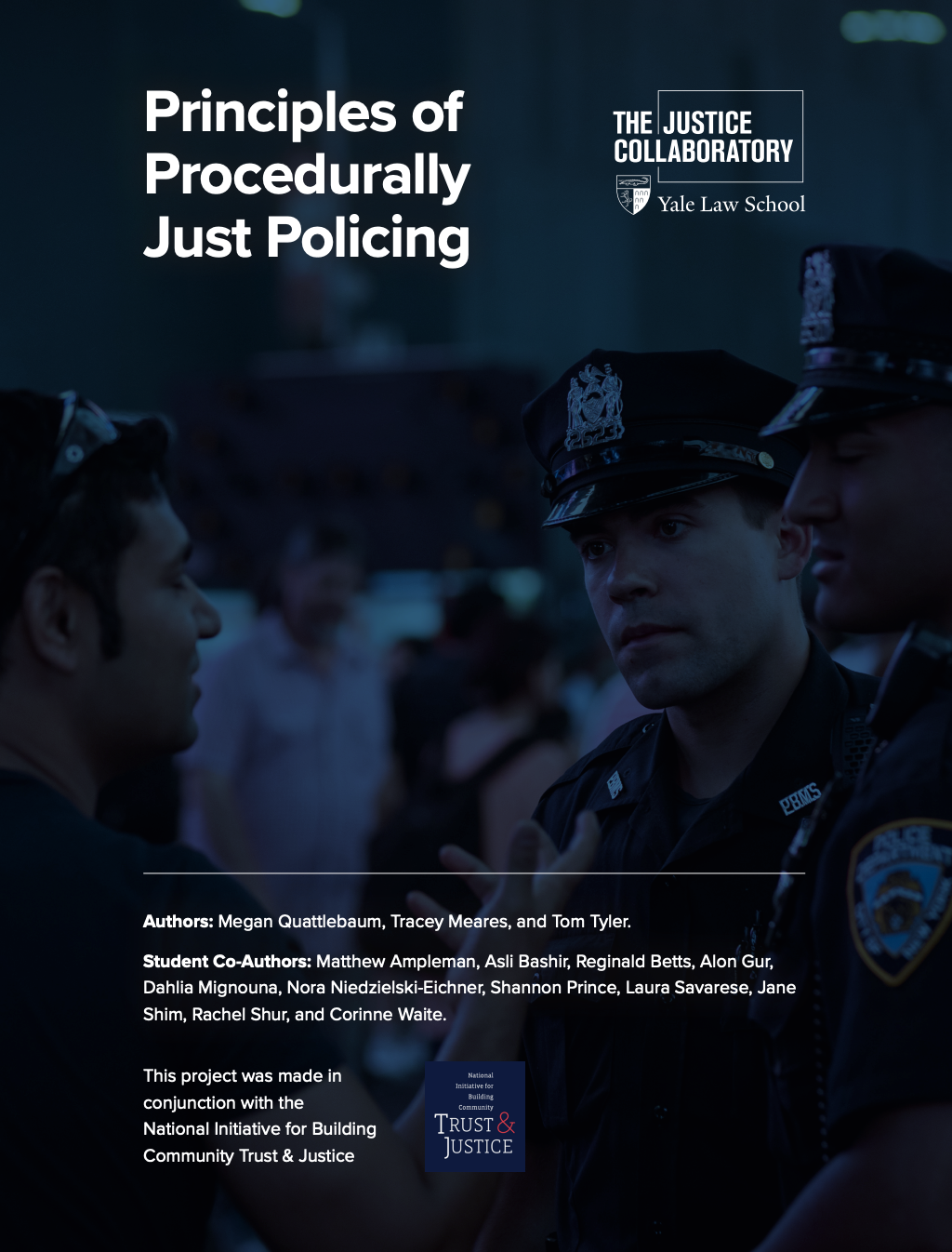
Principles of Procedurally Just Policing
The Principles of Just Policing report offers a new set of practical guidelines aimed at incorporating procedural justice into policing practices.
A Study of Procedural Justice & Criminal Justice System Legitimacy Ensuring a high quality of justice for all and increasing New Yorkers’ trust and confidence in the justice system
Our experiment for the New York City Mayor’s Office of Criminal Justice examined perceptions of procedural justice with both NYC community members and its criminal justice workers.
Report Of The Facebook Data Transparency Advisory Group
In concert with Facebook, Justice Collaboratory faculty co-directors Tracey Meares and Tom Tyler lead a team of seven independent experts to assess the metrics included in the first two versions of its Community Standards Enforcement Report. This Data Transparency Advisory Group (DTAG) created a final report summarizing its findings.